Choosing to whiten your teeth often feels like a tug-of-war between wanting a brighter smile and fearing that sharp, zapping pain known as “zingers.” Many patients here in Aurora walk into my office asking for a Hollywood transformation, but hesitate because they’ve had bad experiences with over-the-counter strips or generic gels. My goal is always to provide a solution that prioritizes your enamel’s health while delivering the aesthetic results you want. Opalescence Boost is a frequent topic of conversation because it bypasses the heat and light associated with traditional whitening, which are often the primary culprits behind post-treatment discomfort.
The Chemistry of Comfort
Opalescence Boost is a chemically activated power whitening gel. Unlike other systems that require a bright, hot UV light or laser to “activate” the whitening agent, Boost works through a unique double-syringe delivery system. This chemical activation means we aren’t dehydrating your teeth with intense light or heat during the process. Dehydration is a major cause of sensitivity; when teeth lose moisture, the microscopic tubules in your dentin become exposed, leading to that uncomfortable physical reaction to air or cold liquids.
Inside the formula, you’ll find 40% hydrogen peroxide, which sounds intense, but it is balanced by a very specific blend of ingredients. This brings us to why Opalescence™ Boost™ Teeth whitening in Aurora has become a preferred choice for our local patients who struggle with thin enamel or previous sensitivity issues. The gel contains potassium nitrate and fluoride. These aren’t just additives; they are essential components that help strengthen the enamel and shield the nerve endings from the whitening process. Think of it as a built-in defense mechanism that works simultaneously with the brightening agent.
Why the “No-Light” Approach Matters
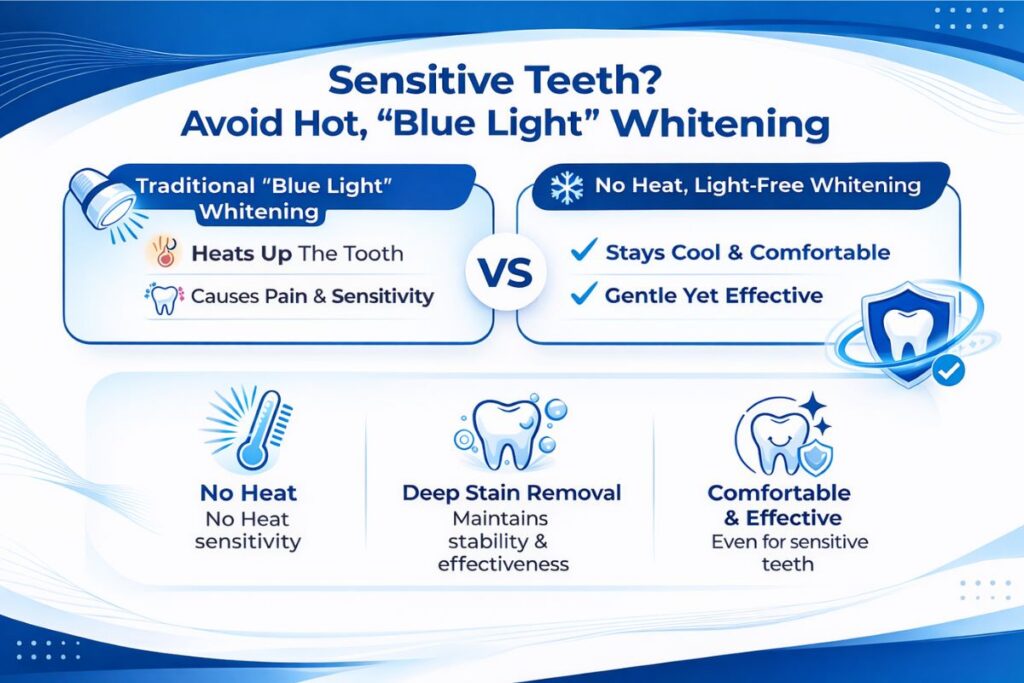
Traditional whitening often uses a “Blue Light” or LED. While these make for great marketing photos, they primarily work by heating up the peroxide to speed up the reaction. This heat also raises the internal temperature of the tooth’s pulp chamber. If you already have sensitive teeth, this thermal change can be incredibly painful. By removing the light from the equation, we keep the tooth at a stable temperature.
I’ve observed that patients who previously couldn’t finish a whitening session due to discomfort often breeze through a Boost treatment. The gel stays refrigerated until use, ensuring the chemistry remains stable and effective. This stability allows the oxygen molecules from the peroxide to enter the enamel and break down discolored molecules without causing the inflammatory response typical of “hot” whitening systems.
What Happens During Your Appointment?
When you visit us for Opalescence™ Boost™ Teeth whitening in Aurora, the process is meticulous. We start by placing a protective barrier—a “liquid dam”—along your gum line. This prevents the high-concentration gel from touching your soft tissues, a common cause of “chemical burns” or white spots on the gums with at-home kits.
Once your gums are protected, I apply the red-tinted gel directly to your teeth. The red color helps me ensure every nook and cranny is covered evenly. We typically leave the gel on for about 20 minutes per application. Because the formula is pH-balanced to match your mouth’s natural environment, it doesn’t strip the minerals from your teeth as more acidic, lower-quality products might.
- Initial Assessment: We check for existing cavities or recession that may need to be addressed first.
- Protection: Gums and lips are shielded to ensure only the teeth are treated.
- Activation: The gel is mixed fresh right before application.
- Post-Treatment: We rinse the gel away and evaluate the shade change.
Managing Expectations with Sensitivity
It is important to be realistic: even the gentlest professional system can cause some mild feedback if your teeth are exceptionally porous. However, the difference lies in the duration and intensity. While a drug-store kit might leave your teeth aching for days, any sensitivity from a Boost treatment usually dissipates within a few hours.
I often recommend that my patients use a desensitizing toothpaste for two weeks before their appointment. This helps “plug” the tubules in the teeth in advance. After the treatment, the fluoride in the Boost gel helps remineralize the surface, meaning your teeth aren’t just whiter—they are structurally supported.
Why Professional Supervision is Non-Negotiable
A common mistake I see is patients trying to “power through” sensitivity with high-strength home gels. This can lead to permanent damage to the tooth’s nerve. By choosing Opalescence™ Boost™ Teeth whitening, you are getting a controlled environment. I can monitor how your enamel reacts in real time. If a patient feels a “zinger,” we can stop, rinse, and adjust immediately. This level of safety simply isn’t possible with a DIY approach.
Aurora residents often deal with varying water mineral levels and lifestyle habits, such as drinking an essential morning coffee from a local shop, that contribute to staining. A professional treatment addresses these deep-set stains while respecting the biological limits of your teeth.
Living with stained or yellowed teeth can take a toll on your confidence, but sensitivity shouldn’t be the barrier that stops you from feeling your best. Opalescence Boost provides a science-backed, light-free, and pH-balanced way to transform your smile in about an hour. If you are tired of guessing which over-the-counter product won’t hurt, it’s time to try a professional approach designed with your comfort in mind.
Contact Young Dental Care today to schedule your consultation and find out if Opalescence Boost is the right fit for you.